Showing posts with label Charleston Scuba. Show all posts

Saturday, June 11, 2011

Plan B


In the world of diving, one must always have a Plan B. Why? Because there are many reasons for a dive not to occur. A month ago I was excited to do my first dive of the "season," only to have it called off due to turbulent seas.


This weekend my dive was called off because not enough divers had signed on to go. It takes so much gas to dive off the coast of Charleston, you have to have a profitable balance of divers to even take the boat out. Charleston Scuba's Sunday dive is full but no one from the Sunday dive trip was willing to go on Saturday. C'est la vie!


Of course, I immediately called other dive options, such as Express Watersports in Murrell's Inlet, which is about an hour and 1/2 +/- drive. But they were only going out to an artificial reef sitting in a depth of 45 feet. So, I didn't feel like it was worth the drive.


My Plan B has turned into a morning to sleep in and relax. Since the majority of my chores are done, I'm thinking about going for a bike ride. Now I just have to decide where I will spin my wheels.


While I'd rather be diving, I guess, I'll just have to settle for exploring the roadways of Charleston. The only thing that would be better is if my parents were close enough to go visit.


Guess Plan B is just a fact of life. :-) What do you do when your dive plan calls for a Plan B?

Enhanced by Zemanta

Tuesday, May 31, 2011

A Perfect Diving Adventure

The water was flat. The Trinity contained nothing but Nitrox tanks and advanced divers. With great anticipation about what would be found on the upcoming wrecks, the divers prepped their gear while Captain Tom expertly drove the boat through the Charleston Harbor out to sea.


The latter sounds like the beginning of a fictional story, but it really happened this Memorial Day. In fact, I would have to say I found it to be an absolutely perfect diving adventure. You see, in addition to the awesome conditions, the boat was perfectly balanced. Two people canceled at the last minute but still had to pay (due to the 48 cancellation policy), which made it a win-win for everyone. Tom and Sally didn't lose any money and we had more space to knock around on the boat. (And we had some really fun people to dive and hang out with on board.)


A uneventful two-hour boat ride set us over our first dive site - the tugboats. This artificial reef was created in 1995 when Captain Tom joined one of his friends to intentionally sink a tugboat off the coast of Charleston.


Tom recounted the event to me as we sped out to the site. The most striking point was when he recalled standing on the deck as it filled with water from the open valves. He was ready to evacuate, but his friend encouraged him to stay for a bit to experience the sinking before bailing to safety. (The emotion he felt had to be intense.)


Today the tug sits in 105 feet of water. With parts still intact, divers can easily navigate through the wheelhouse and "walk" on the deck. Peering into portholes, the tugboat's hull and parts unknown, this underwater photographer was in heaven. The growth on the tugboat was thick and full of vibrant colors. Fish of all kinds were in abundance.


The second site we dove on is the USCG Comanche, a former icebreaker used on the Great Lakes. Scuttled (deliberately sunk) in 1992, this 165-foot U.S. Coast Guard cutter provided me with an exhilarating dive site. The top of the boat can be reached at about 80 feet and the bottom at 110 feet. (This has to be my favorite dive sites, to date!)


The visibility on both of these sites varied but was still great for taking photos. From the heat of the surface to the cool depths of the ocean,  my camera lens was full of a light condensation due to the rapid change in temperature. But after after a few minutes on the tugboat, the temps leveled out and my photos came into focus. (A photo bucket was used in between dives to ensure that didn't happen on the Comanche.)


I maintained a depth of 92-97 feet for most of my bottom time, with an occasional drift down to 101 at maximum depth. My 5MM wetsuit was perfect as the 68-72 degree temps were quite brisk.


Personally, I can't wait to dive on these sites again. Until that time, I'll just have to revisit my photos to relive it...


Amberjack on the deck of the Comanche.
This photo shows how far my strobe casts light.
My dive buddy, Sally Robinson!


This is a ladder encrusted with corral.


You have no idea how fast this little damsel fish moves. I'm proud of these two shots.


Enhanced by Zemanta

Sunday, May 29, 2011

The Anchor Wreck

I was fortunate enough to dive the Anchor Wreck again on Saturday with my adopted Charleston Scuba family. This amazing dive site was created when a yet-to-be identified ship sank near Bull's Bay off the coast of Charleston in the mid- to late-1800s.


Not much is left of the 300 ft. freighter, thought by some to have carried some type of perishable cargo such as bananas or sugar. Sitting in 105 feet of water, the double boilers can be accessed at about 80 feet.


While most boat captains are secure in the fact that the wreck has yet to be identified, others think the Anchor Wreck may be the Norwegian steamship called the Leif Erickson. After listening to Captain Tom share how they i.d. wrecks, I'm sticking with his view that it has yet to be identified.


Regardless of what the ship is, this is a marvelous dive for advanced divers. To get there one must sustain a long boat ride (2 hours and 40 minutes one-way, give or take the surface conditions), but it is well worth it for seasoned divers and underwater photographers.


I found the wreck to be covered with lot of vibrant growth. It was surrounded by giant, somewhat aggressive amberjack and walls of bait fish so thick you had to push through them to actually see the wreck. There were tons of flounders trying to camouflage themselves all over the wreck. And reticulated moray eels peering out of crevices were everywhere you looked.


I stayed at about 92-97 feet the majority of my bottom time. Nitrox made this possible, as did being surrounded by expert divers like Dive master Tim Schmitz. The water temp hovered between 68-72 degrees at depth, so the thermolclines felt wonderful. I'm SO glad I decided to wear my 5MM wetsuit.


This was a great way to kick off the dive season and try out my new strobe. But don't take my word for it, let my pictures do the talking. (Be sure to click on each one so you can view up close and really see what is in each photo.)


Sunday, September 26, 2010

Diving with Charleston Scuba

We went out with Charleston Scuba to dive on the Little Garden Ledges. Surprisingly there were more women divers on the boat than I can remember in quite some time. I enjoyed that fact immensely. The surface was relatively calm with a breeze and light chop. We encountered some rain at one point, but it was refreshing and brief.


The Little Garden Ledges were amazing and I wish we'd had more time to explore them. Lee found some great fossilized shells. I took spent my time taking close up photos, due to a high level of particles in the water and extremely low visibility.


Michelle Tallerico was our dive master. It's always awesome to go out when she is on the boat. She is fun, knowledgeable, sweet and kind. Tom Robinson, co-owner of Charleston Scuba, drove us on his wonderful boat, the Trinity. Tom adds color, knowledge and experience to his charters like none other.


Take a look at some of my photos. (I can't wait until next season to get my strobe; it will help show the true beauty and colors.) There is more commentary at the end of the photos being displayed.


Spiny Sea Urchin
Bait fish


Sponge (it was squishy to the touch)
Baby Hogfish

Baby Queen Angel
Sheep Head Fish
Look for the Fish and Christmas Tree Worms...
Basket Sponge
Giant Amber Jack

Look for the tropical fish... do you see it?

Giant shell Lee found with my light shining on it
Looks like a spider to me, but I was told it is an Anchor Crab

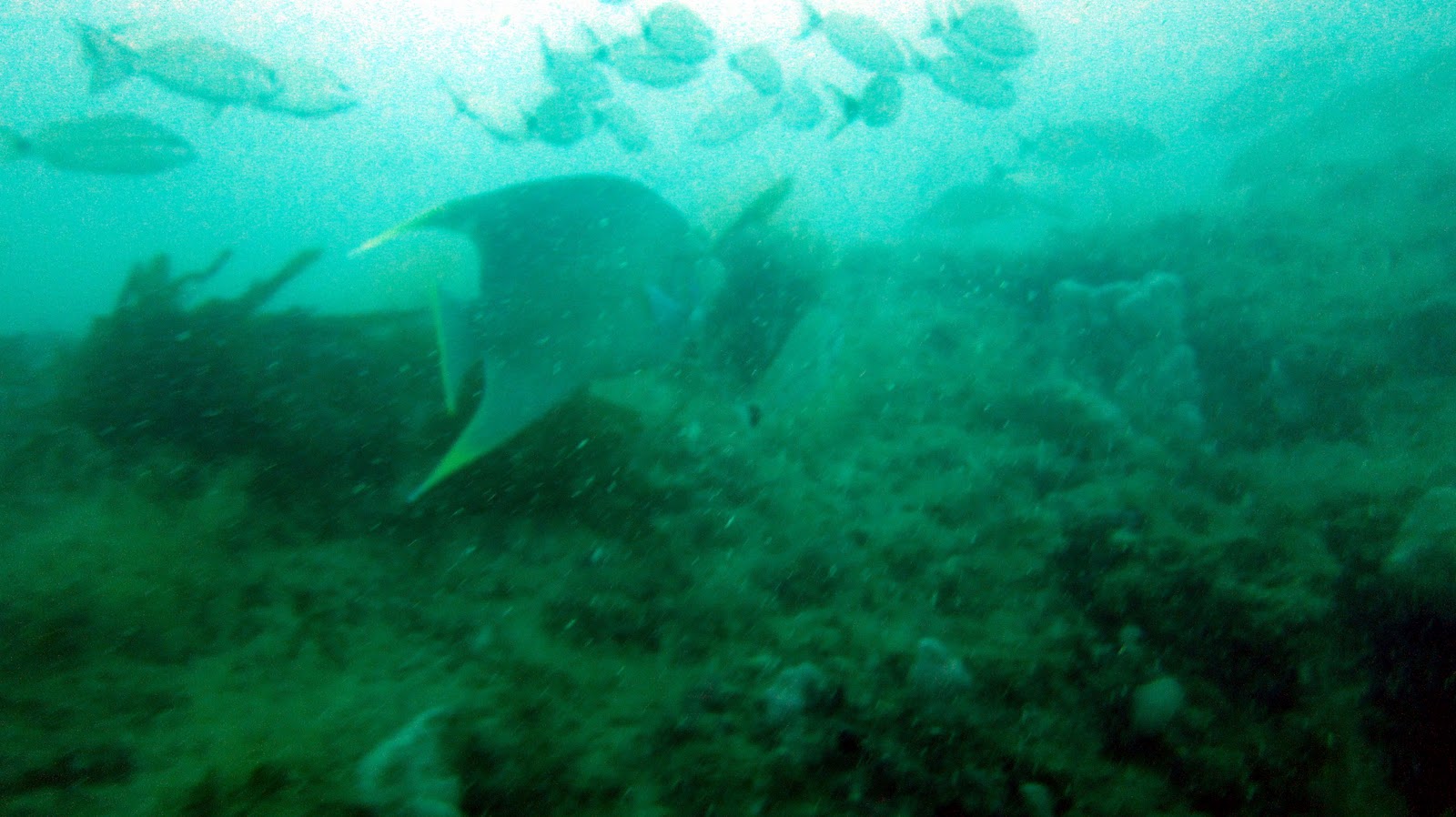
Giant Queen Angel - was really faded out in person - thinking it is at the terminal phase

Lee

White Basket Sponge
Sea Urchin with my light shining on it

I also spent my time clearing my mask and dealing with burning eyes. This was not fun. In fact, it was downright miserable by the second dive. But I learned something valuable. When one cleans their mask by taking out the purge valve - not all masks have these - make sure you put it back in correctly. An upside down purge valve causes your mask to leak like there is no tomorrow.


Any day diving is a good day. I'm looking forward to where Lee and I go diving next.